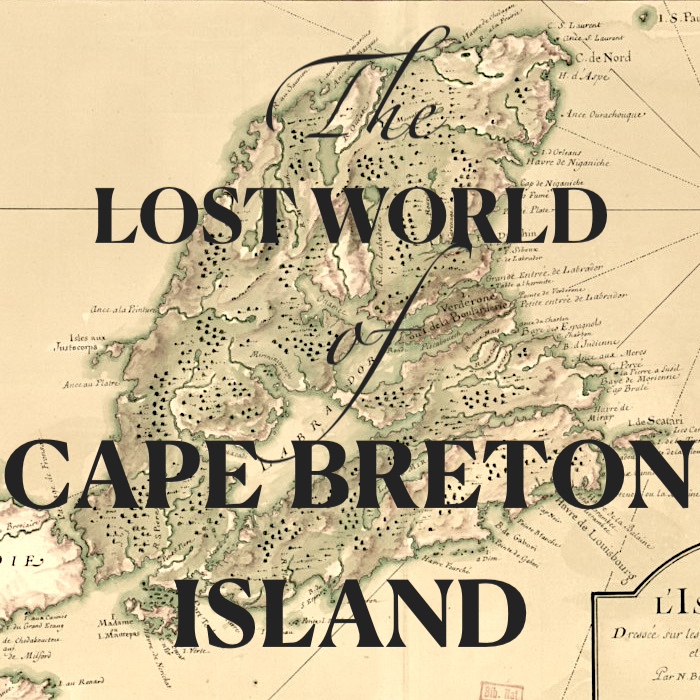
The Lost World of Cape Breton Island Podcast is a Canadian history project that uncovers the forgotten stories of 18th-and 19th-century Cape Breton, Nova Scotia. Through primary sources like journals, memoirs and correspondence, we will explore Cape Breton’s history with the help of those who witnessed it firsthand. Listen to the mad ramblings of a Scottish exile as he describes what life was like in the Fortress of Louisbourg, follow the rising career of a French sailor destined to explore the world, and feel the despair as an aristocratic trailblazer struggles to eke out a living on Cape Breton’s unforgiving shores.
The Lost World of Cape Breton Island is written and researched by J.M. Bourgeois, and produced and edited by J.R. Bourgeois.
Written at Louisbourg on September 1, 1755, this remarkable letter from Antoine de La Boularderie offers a rare first-hand account of life, war, and loss in 18th-century Île Royale (Cape Breton Island). Addressed to the French Minister during a period of escalating conflict between France and Great Britain, the correspondence details Boularderie’s military service, the destruction of his estate, and his heartfelt appeal for royal recognition, including the Cross of Saint Louis. Preserved in Les Derniers Jours de l’Acadie by Gaston du Boscq de Beaumont, this primary source document remains an invaluable window into the fall of Louisbourg and colonial Acadia, offering rich insight for anyone interested in the history of 18th-century Cape Breton.
Follow Antoine de La Boularderie and his family as they navigate the most violent and uncertain years in Cape Breton’s history. As the shadow of the 1758 siege looms over the Fortress of Louisbourg, the Boularderies find themselves caught between a crumbling empire and an inevitable invasion. Experience a story of upheaval, survival, and the displacement that redefined Cape Breton forever.
In 1744 the French and English beat the drums of war, and Antoine de La Boularderie finds himself in the middle of a conflict that rages across Cape Breton Island and Acadia. In the second part of this episode, we will listen to Antoine’s eyewitness account of the days leading up to the first siege of Louisbourg. We will also visit Little Bras d’Or, a once thriving French settlement in the heart of Cape Breton and the home of the Boularderie Family.
Although Antoine Le Poupet de La Boularderie and his father Louis-Simon have been designated Canadian Historic Persons – individuals who made significant contributions to the history of Canada – their story has only ever been partially told. Part of their story can be found on Cape Breton Island, another part in France, and still another part in the American State of South Carolina. Who were the Boularderies? How did they impact the early history of Cape Breton Island and Canada? And how is it that their story is so fragmented? In order to answer these questions, we will reassemble the family’s entire story for the first time.
The audio book The Acadians was produced in collaboration with the Canadian Historical Association. This book is booklet #33 of the CHA’s Immigration and Ethnicity in Canada booklet series. Founded in 1922, the Canadian Historical Association / La Société historique du Canada is a bilingual not-for-profit and charitable association devoted to fostering the scholarly study and communication of history in Canada. The Association seeks to encourage the integration of historical knowledge and perspectives in both the scholarly and public spheres, to ensure the accessibility of historical resources, and to defend the rights and freedoms of professional and emerging historians in the pursuit of historical inquiry.
BONUS EPISODE – John Montresor Walks the Old French Road, March 1759
As “Keeper of the King’s Instruments” for Louis XV, Christophe Chiquelier Jr’s work was endless but no doubt fulfilling. He was a master musical instrument maker, supplier of harpsichords to the Royal Family, and an instrument collector. But for a brief time during his youth, he was a soldier in Louisbourg, the capital of the French colony of Île Royale, known today as Cape Breton Island.
The finale of our three part series on the life and times of James Johnstone. Follow the Chevalier de Johnstone’s escapades in Cape Breton from 1756 through to 1758 and see how this Scotsman’s memoirs tell the long forgotten stories of Cape Breton’s past.
Travel back in time to the year 1753 and see Cape Breton Island through the eyes of Scottish exile the Chevalier de Johnstone. We will also bridge two very different eras in Cape Breton’s past – the French colonial period of the early 18th century, and the era of Scottish migration that took place in the 19th century.
The Chevalier de Johnstone is one of the most colourful personalities to have come through Cape Breton in the 18th century. A Scottish exile who was involved in the 1746 Jacobite Rebellion, Johnstone was likely one of the only – if not the only – Scotsmen in Cape Breton during the time of Louisbourg. He is often in the right place, but simply not at the right time.
Near the shores of the Mira River halfway through the 18th century sat two small villages now lost to time – Village des Allemands and Village Rouillé. Though existing for only six short years, the stories these villages tell reflect the greater challenges that typified the Canadian maritime region during the 1750s.
For centuries, Cape Breton Island has seen waves of settlers come ashore from many different parts of the world. The ebb and flow of peoples spurred on by the effects of war, by enterprise or by the simple desire to put food on their table has shaped the cultural fabric of the island for hundreds of years. Bretons, Normans and Basque arrived during the 18th century when the island was under the jurisdiction of New France, and then in the early 19th century the Gaelic speaking inhabitants of places like Barra and Uist put down permanent roots seeking refuge and a new beginning. As the tides of immigration and settlement came and went, communities likewise did the same. In this episode, we’ll discuss one of these communities at length – St. Esprit.
In the age of Pacific exploration, two men spearheaded expeditions to parts of globe previously uncharted by Europeans – Jean François de La Pérouse and James Cook. Although La Pérouse and Cook would never meet, both men would converge on Cape Breton Island in the year 1758, near the beginning of their careers. This episode takes us from the port of Rochefort, France to the idyllic settlement known today as Englishtown, and then on to the shores of Gabarus Bay.
Jean-François de La Pérouse was one of the most renowned mariners and explorers of the 18th century, but in 1788 he and his expedition disappeared without a trace, leaving behind a mystery that would take decades to unravel. La Pérouse visited Cape Breton Island several times during his early years at sea – this episode introduces La Pérouse and touches on his visit to the Fortress of Louisbourg in 1757.
Note – Since the publishing of this podcast, historian Éva Guillorel from the University of Rennes in France has done significant research into the origins of “La Complainte de Louisbourg.” She has uncovered evidence that this Acadian folksong is based on an older French song written about one of the sieges of Philippsburg. Her findings were published in the Spring 2022 edition of the journal Acadiensis and updates some of the information found in this episode.
Two strong links exist between the Acadian village of Chéticamp and the French fortress of Louisbourg – Jeanne Dugas and the family of Joseph Gaudet. The third installment of our episode on the Acadian folk song “Louisbourg’s Lament” examines the life and times of these two people and the experiences of their immediate families.
Note – Since the publishing of this podcast, historian Éva Guillorel from the University of Rennes in France has done significant research into the origins of “La Complainte de Louisbourg.” She has uncovered evidence that this Acadian folksong is based on an older French song written about one of the sieges of Philippsburg. Her findings were published in the Spring 2022 edition of the journal Acadiensis and updates some of the information found in this episode.
The second part of episode 2 analyzes the lyrics of “Louisbourg’s Lament” in order to see how it holds up against the historical record of the fall of Louisbourg in 1745. Special thanks to Robert Deveaux, folklorist and song keeper from Chéticamp, for supplying much of the information regarding “La complainte de Louisbourg”.
Note – Since the publishing of this podcast, historian Éva Guillorel from the University of Rennes in France has done significant research into the origins of “La Complainte de Louisbourg.” She has uncovered evidence that this Acadian folksong is based on an older French song written about one of the sieges of Philippsburg. Her findings were published in the Spring 2022 edition of the journal Acadiensis and updates some of the information found in this episode. In the first part of our second episode, we examine the traditional Acadian song “La Complainte de Louisbourg”, or “Louisbourg’s Lament”, a song believed to have originated with an eye-witness to the 1745 Siege of Louisbourg.
In our first episode, we introduce the Lost World of Cape Breton project. We also follow John Montresor, an engineer in the British army, overland from Louisbourg to the shores of the Bras d’Or Lakes as he embarks on an “inland scout” in the months following the fall of Cape Breton Island to the British.
 The Lost World of Cape Breton Island